

Deploy to multiple clusters using Rancher
NoteThese instructions apply to tenants created on or after June 6, 2025. If your tenant was created earlier, follow the legacy guide: Deploy the Observe Agent to Multiple Kubernetes Clusters Using Rancher [Legacy]. Interested in upgrading to the new experience? Open Docs & Support → Contact Support in the product and let us know.
You can simplify deployment of the Observe Agent across multiple Kubernetes clusters by leveraging Rancher. Follow the steps below to configure Rancher with your fleet.yaml file, add necessary secrets, and manage distribution via Continuous Delivery.
Prepare fleet.yaml
-
Create a GitHub repository (or an equivalent VCS)
Use this repository to hold yourfleet.yamlfile and any future updates or configurations. -
Add
fleet.yamlto your repository
Commit the following contents into your repo asfleet.yaml. Replace<YOUR_OBSERVE_COLLECTION_ENDPOINT>with your instance's collection endpoint (ex: https://123456789012.collect.observeinc.com/).
defaultNamespace: observe

helm:
  chart: "agent"                    # chart name
  repo: "https://observeinc.github.io/helm-charts"
  # version: "0.51.1"
  releaseName: observe-agent

  # Enable or confirm "disablePreProcess" is false so Fleet processes templating.
  # (This is usually the default, but some Fleet versions require you to specify.)
  disablePreProcess: false

  values:
    agent:
      selfMonitor:
        enabled: false
    application:
      prometheusScrape:
        # Set it to false if you don't want to use Prometheus Autodiscovery to scrape Prometheus metrics from your pods.
        enabled: true
    cluster:
      events:
        enabled: true
      metrics:
        enabled: true
      # If a cluster does not have the env label, the expansion becomes an empty string—meaning the name might become "-monitored-cluster".
      # If you want a fallback, you can do something like:
      name: "${ index .ClusterLabels \"env\" | default \"unknown\" }-observe-monitored-cluster"
    node:
      enabled: true
      containers:
        logs:
          enabled: true
        metrics:
          enabled: true
      forwarder:
        enabled: true
        traces:
          enabled: true
        metrics:
          enabled: true
          outputFormat: "otel"
        logs:
          enabled: true
    observe:
      collectionEndpoint:
        value: "<YOUR_OBSERVE_COLLECTION_ENDPOINT>"
      token:
        create: false
      traceToken:
        create: false
Configure Rancher
-
Add the Observe by Snowflake Helm repository
-
In Rancher, go to Cluster Management > Repositories.
-
Create a new repository using
https://observeinc.github.io/helm-chartsas the URL.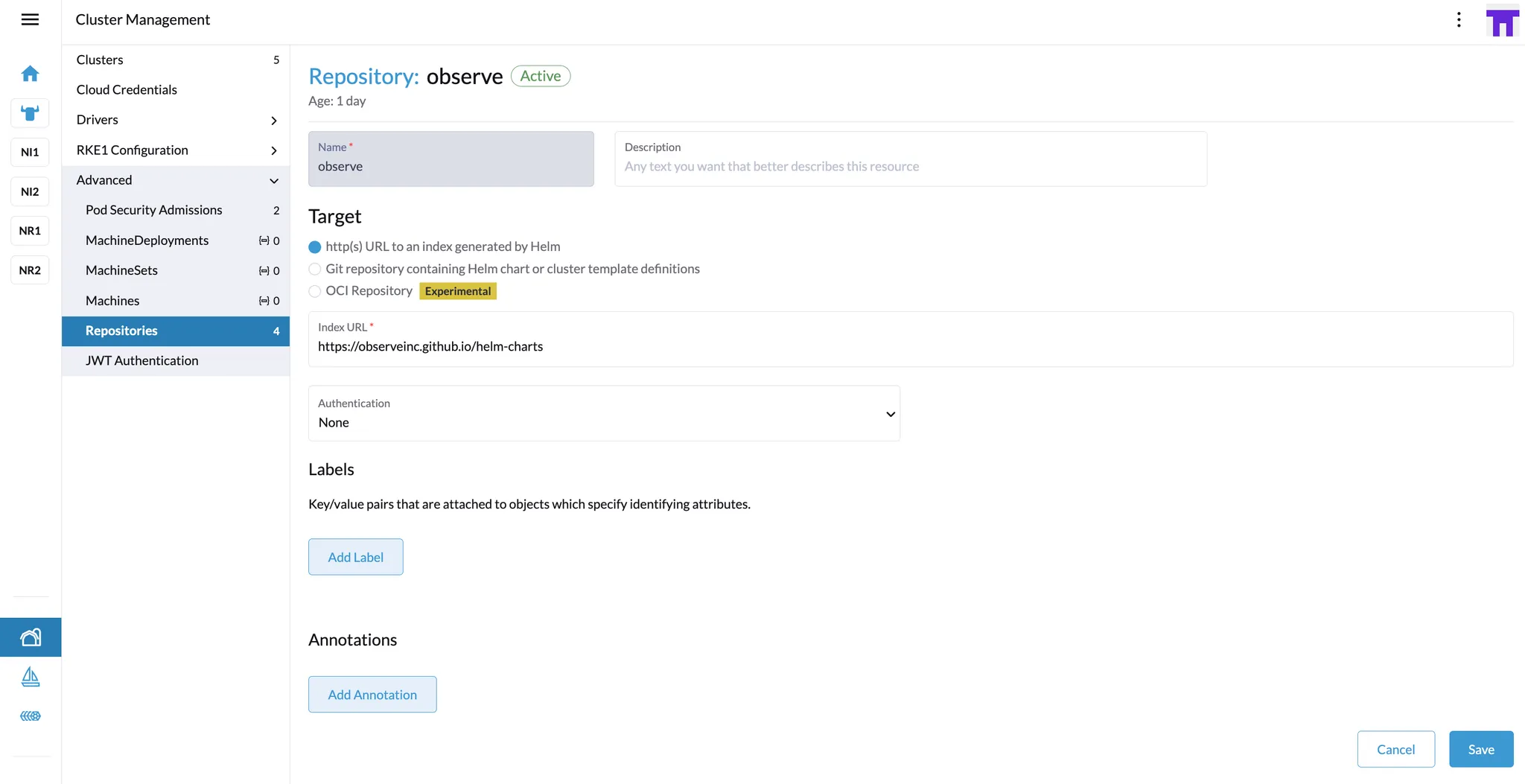
-
-
Create a Secret for Each Kubernetes cluster.
- Select a cluster in Rancher, then navigate to Secrets.
- Add a new secret with the following settings:
-
Type:
Opaque -
Name: For example,
agent-credentials. -
Namespace:
observe(or another namespace, but presumablyobserveif you’re deploying the Observe Agent there). -
Key-Value Pairs: Use
OBSERVE_TOKENas the key, and the ingest token you create from the Add Data for Kubernetes page, such asds1gF7ZGV52S....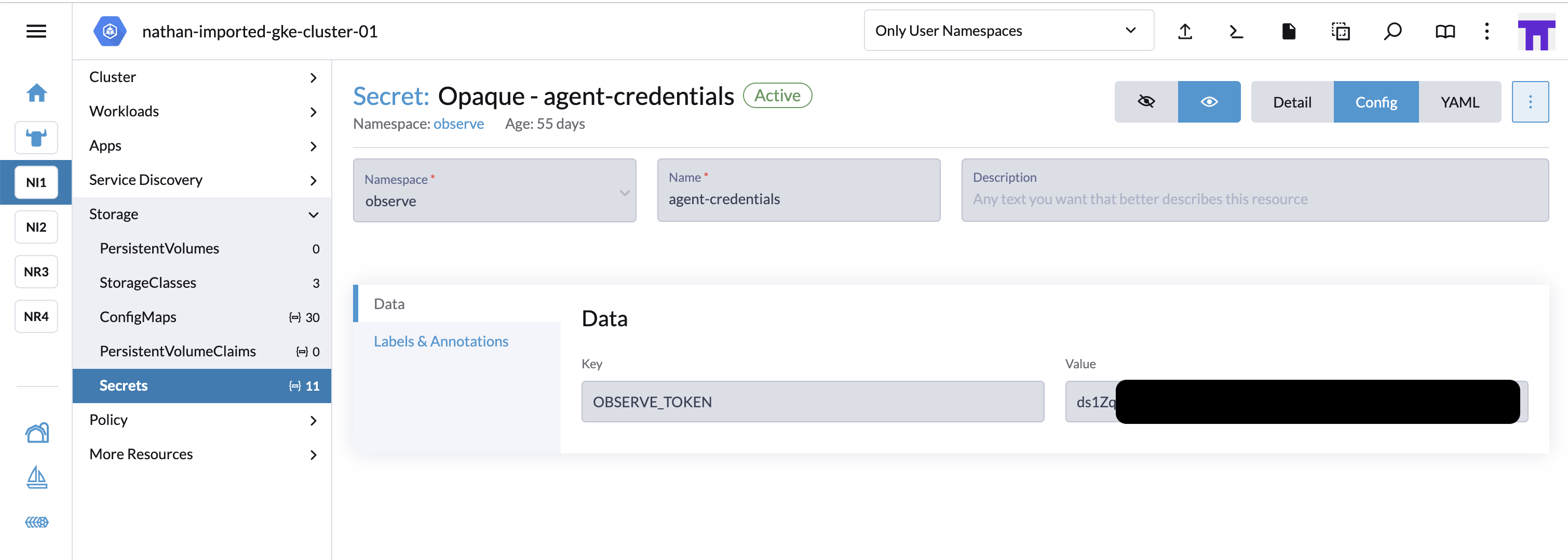
-
-
Add Your GitHub Repository in “Continuous Delivery”
-
Go to Continuous Delivery → Git Repos in Rancher.
-
Add a new Git repository, using the link to the repository containing your
fleet.yaml, such ashttps://github.com/observeinc/observe-rancher-test.git.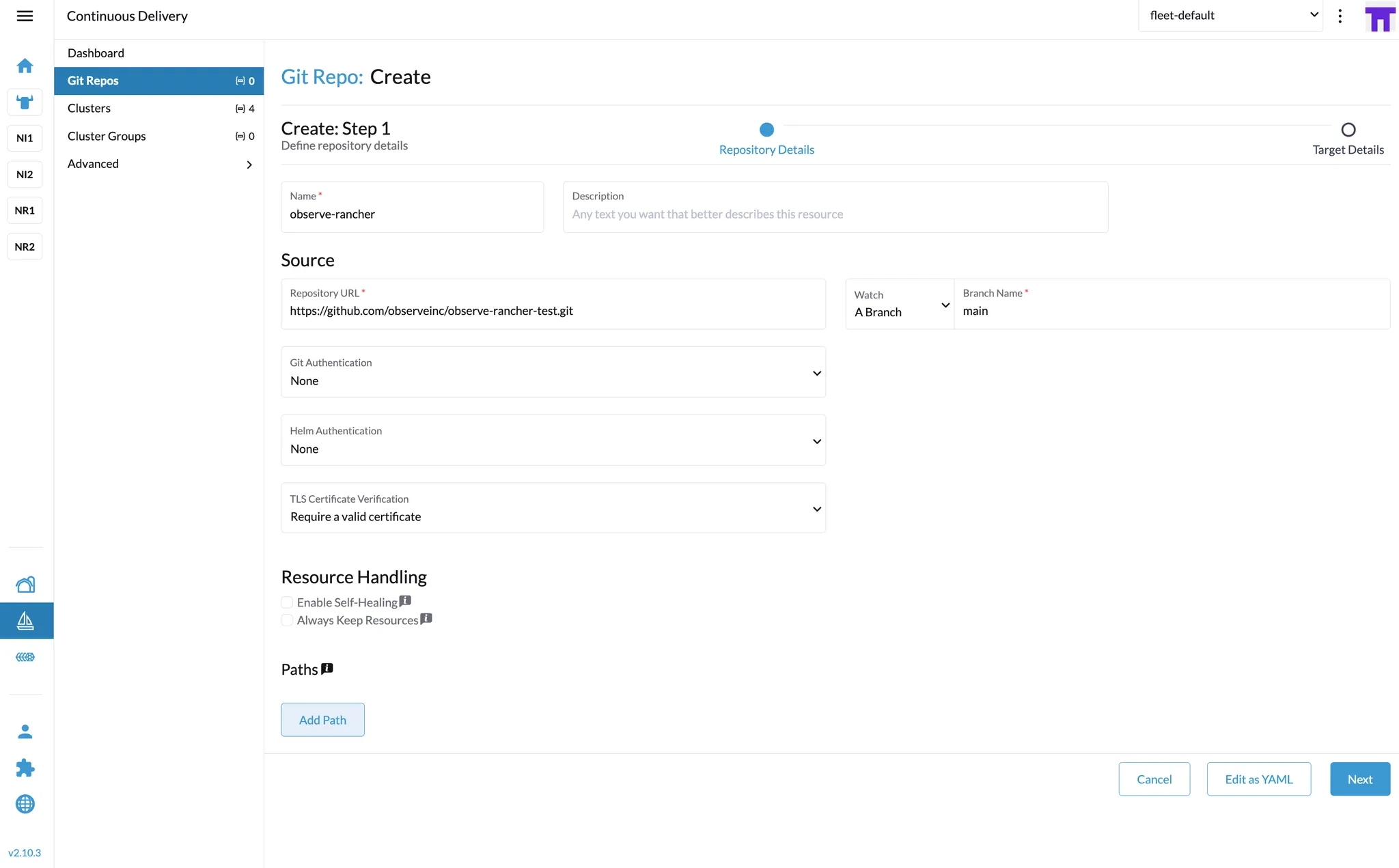
-
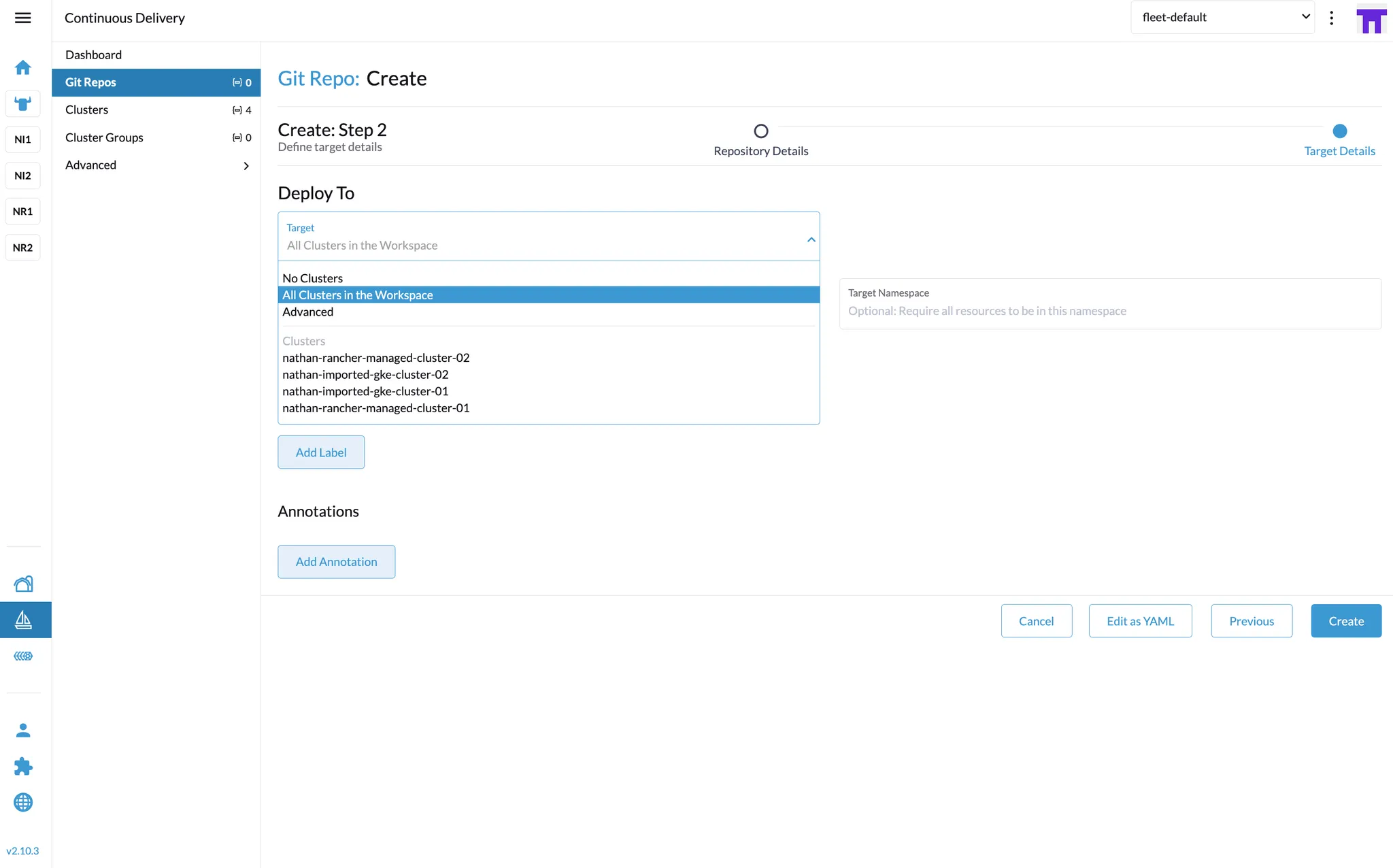
Choose target clusters to deploy the Observe Agent.
-
Wait for Rancher to synchronize and deploy the Observe Agent to each selected cluster.
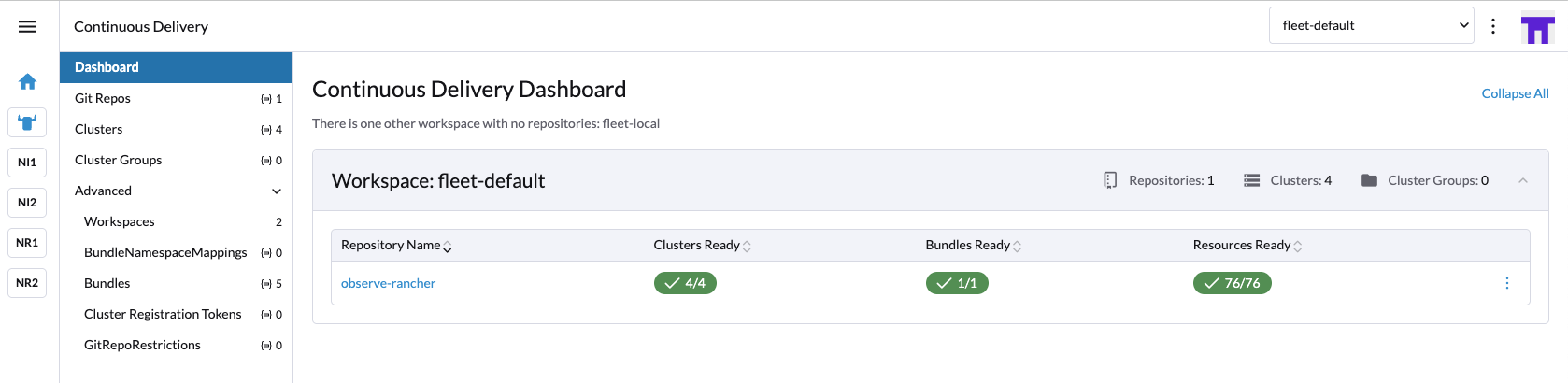
-
-
Verify Deployment
Once the process completes, check Kubernetes Explorer in your Observe by Snowflake account (or your chosen monitoring view) to confirm the Observe Agent is reporting data as expected.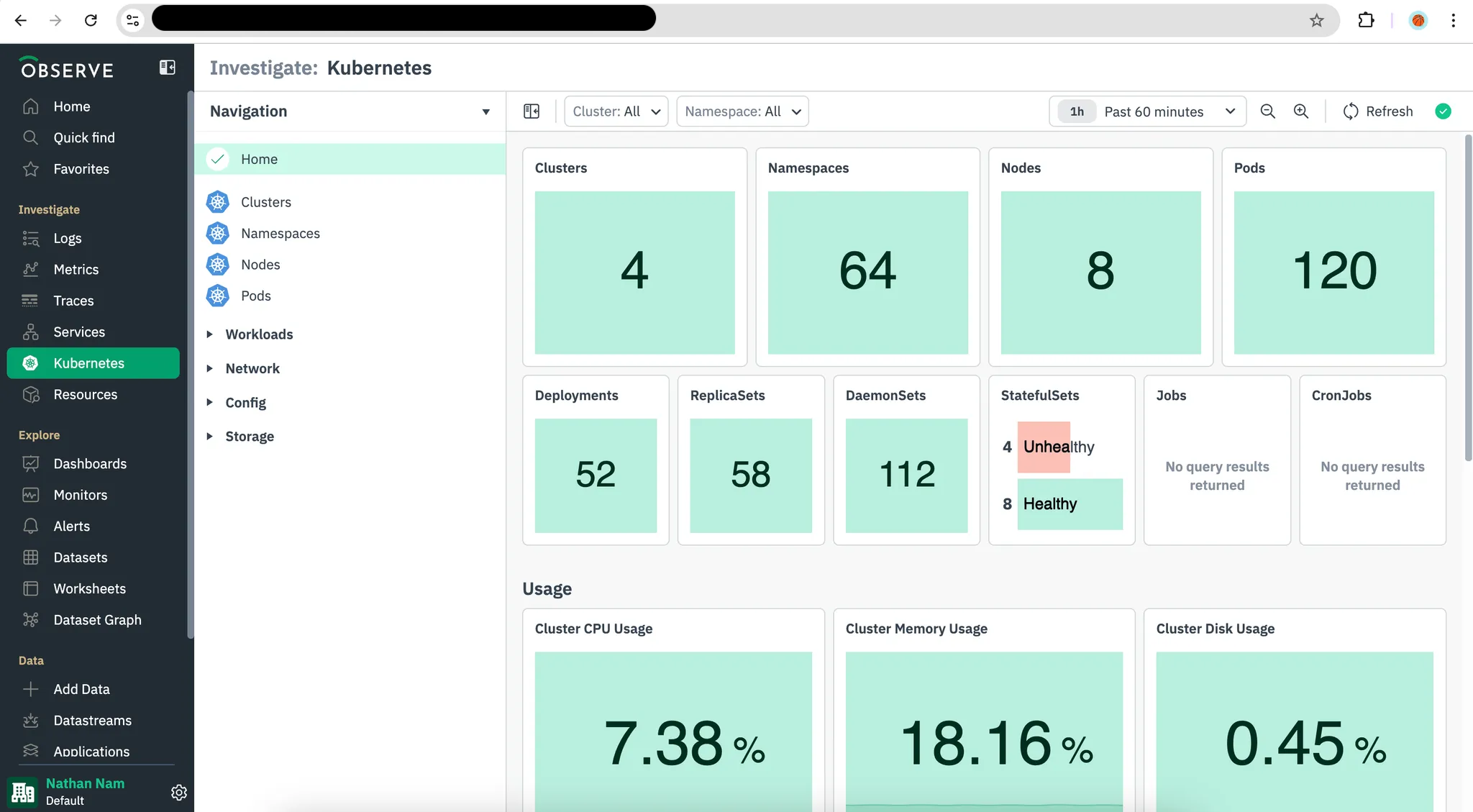
Configure application instrumentation
Once the Observe Agent is deployed, configure your application instrumentation or set the OTEL_EXPORTER_OTLP_ENDPOINT environment variable to one of the following addresses to send application telemetry including traces to the Observe Agent.
Note
When setting up the endpoint to send traces, make sure you use the path that your OTLP library requires. Some libraries need traces to go to
/v1/traces, while others expect them at the root path/.
- OTLP/HTTP endpoint: http://observe-agent-forwarder.observe.svc.cluster.local:4318
- OTLP/grpc endpoint: http://observe-agent-forwarder.observe.svc.cluster.local:4317
For example, if you are using the OpenTelemetry Astronomy Shop Demo app, create the app.yaml.
default:
  envOverrides:
  - name: OTEL_EXPORTER_OTLP_ENDPOINT
    value: 'http://observe-agent-forwarder.observe.svc.cluster.local:4318'
Upgrade the helm chart for the OpenTelemetry Astronomy Shop Demo app.
helm upgrade --reuse-values -f app.yaml my-otel-demo open-telemetry/opentelemetry-demoSee APM instrumentation for more information about. how to instrument your app.
Updated about 1 month ago
What’s Next
Use the Kubernetes Explorer to monitor your Kubernetes clusters. To analyze your trace data, explore both the Trace Explorer and the Service Explorer.