

Configure your own OTel collector on Kubernetes
This page describes the recommended way to configure a plain OTel collector on Kubernetes to get data into Observe by Snowflake so that the proper Datasets are created to power core functionality in the Logs, Metrics, Trace, and Service Explorers.
Follow these instructions to get your data into Observe by Snowflake if you have a situation where you don't want to use the Observe Agent.
You can also configure and deploy custom OTel collectors without Kubernetes. See Configure your own OTel collector without Kubernetes.
Breaking change!Beginning July 1, 2026, new tenants are provisioned with
APM.flagREDMetricsGeneratedByAgent = trueby default. This flag switches the Service Explorer to query pre-computed RED metrics that the Observe Agent generates. Your custom OSS OTel collector (not the Observe Agent) won't product those metrics, which causes the Service Explorer to show 0 requests per second. To work around this issue, set the property tofalse:APM.flagREDMetricsGeneratedByAgent = false
Prerequisites
Verify the following assumptions and prepare for incoming data before you continue with setting up your own OTel collector.
Assumptions
The instructions in the document are based on the following assumptions:
- You already have your own OTel collector running, and you are familiar with setting up the infrastructure required by the OTel collector. If either one is not true, use the Observe Agent.
- The following placeholders are used throughout the document (the
$$sign helps differentiate them from variables):$$OBSERVE_OTEL_ENDPOINTindicating the customer-specific HTTP collect endpoint for OTel data, such ashttps://123456.collect.eu1.observeinc.com/v2/otelfor customer ID123456.$$OBSERVE_PROM_ENDPOINTindicating the customer-specific HTTP collect endpoint for Prometheus metrics data, such ashttps://123456.collect.eu1.observeinc.com/v1/prometheusfor customer ID123456.$$EXPLORER_PACKAGEset to eitherKubernetes Explorerfor a Kubernetes use case, orHost Explorerfor everything else. See Prepare for incoming data. The reason for this definition is that logs and Prometheus metrics are segregated in this form per current convention.
- Your existing OTel collectors have receivers set up corresponding to the type of data being processed and the sources the data is coming from. In this document, the receiver types are referred to as
$$metric_receiver(s),$$trace_receiver(s), and$$log_receiver(s), along with$$otel_metric_receiver(s)and$$prom_metric_receiver(s)to differentiate between Prometheus and OTel metrics sources.
This document focused on how to set up processors and exporters into pipelines for ingesting correctly enriched data into Observe by Snowflake.
Where required, we’ll also suggest additional configurations to your instrumentation SDK respectively your application, but assume again that basic setup is in place to export to the corresponding OTel collector receivers.
Prepare for incoming data
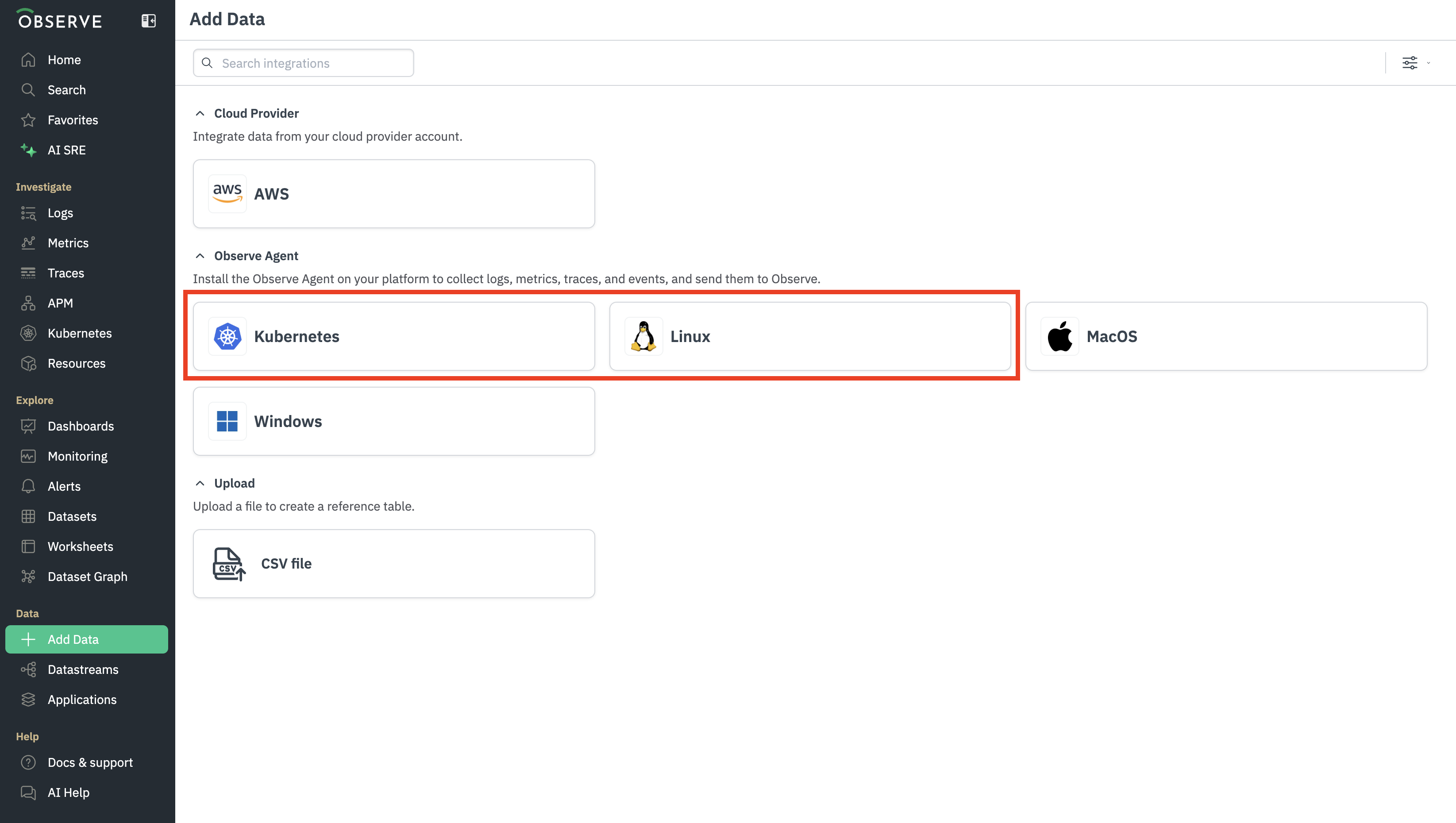
Use the Add Data portal to perform a one-time setup for the source Datasets that will receive the incoming data.
- Configure a Kubernetes integration if you want to configure the collector in a Kubernetes environment.
- Configure a Linux integration for all other environments, even if you are not running on Linux.
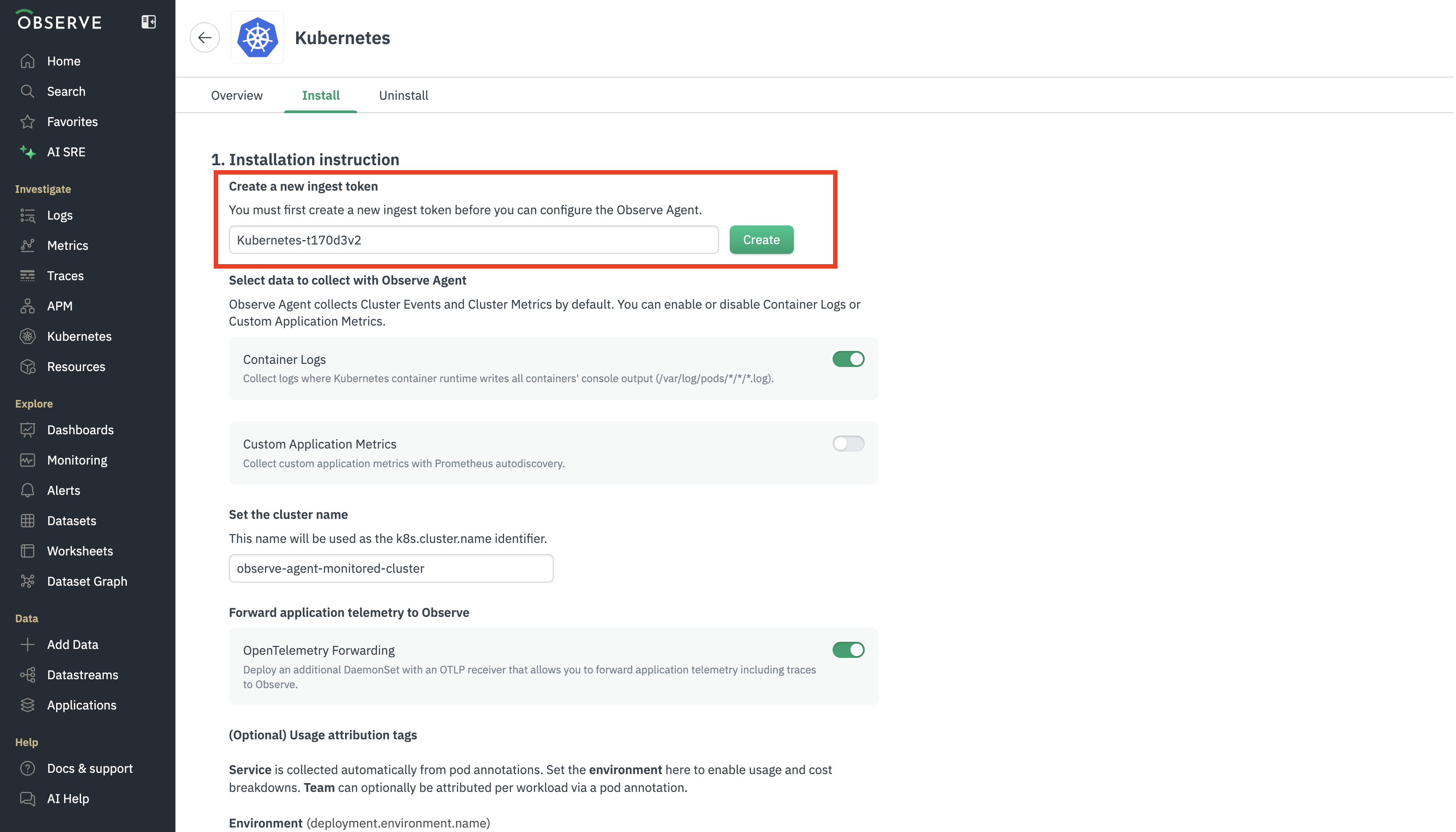
As part of this setup, you will create an ingest token to authenticate the collector with Observe by Snowflake. Create separate tokens for each cluster, deployment, or team.
The following example shows this step in the Kubernetes instructions:
Basic setup
Common Observe by Snowflake Agent/processor setup
Use an appropriate secret store to store the Ingest token and make sure the token is available to the collector from the OBSERVE_TOKEN environment variable. See Collector configuration best practices in the OpenTelemetry documentation.
Other best practices are summarized below:
- Set a
memory_limiterprocessor. For example:
memory_limiter:
  check_interval: 5s
  limit_percentage: 80
spike_limit_percentage: 15- Set up a batch processor. For example:
  batch/observe/metrics:
    send_batch_max_size: 20480
    send_batch_size: 16384
    timeout: 1s
  batch/observe/logs:
    send_batch_max_size: 4096
    send_batch_size: 4096
    timeout: 5s
  batch/observe/traces:
    send_batch_max_size: 4096
    send_batch_size: 4096
timeout: 5s- Add cloud resource detectors, which require the
otelcol-contribcontrib collector:
  resourcedetection/cloud:
    detectors: ["eks", "ecs", "ec2", "gcp", "azure"]
    timeout: 2s
    override: false
Kubernetes setup
- Set up a
k8sattributesprocessor, as shown in the following example. See Important Components for Kubernetes in the OpenTelemetry documentation.
processors:
  k8sattributes:
    extract:
      labels:
      - from: pod
        key_regex: (app\.kubernetes\.io/.+)
        tag_name: $1
      metadata:
      - k8s.namespace.name
      - k8s.deployment.name
      - k8s.replicaset.name
      - k8s.statefulset.name
      - k8s.daemonset.name
      - k8s.cronjob.name
      - k8s.job.name
      - k8s.node.name
      - k8s.node.uid
      - k8s.pod.name
      - k8s.pod.uid
      - k8s.cluster.uid
      - k8s.container.name
      - container.id
      - service.namespace
      - service.name
      - service.version
      - service.instance.id
      otel_annotations: true
    passthrough: false
    pod_association:
    - sources:
      - from: resource_attribute
        name: k8s.pod.ip
    - sources:
      - from: resource_attribute
        name: k8s.pod.uid
    - sources:
      - from: connection
    wait_for_metadata: false
    wait_for_metadata_timeout: 10s
This is close to the standard setup vended by Observe Agent. If you’re not interested in all the information you can drop the corresponding entries from metadata respectively.
- In order to power Service Explorer, the fields
service.nameandservice.namespacemust be added to any span data. They are automatically derived per Specify resource attributes using Kubernetes annotations.l - Most functionality requires a cluster and deployment environment to be specified. For example:
processors:
	resource/observe_common:
	  attributes:
	    - key: k8s.cluster.name
	      action: upsert
	      value: $$CLUSTER_NAME
	    - key: deployment.environment.name
	      action: upsert
	      value: $$ENVIRONMENT
Others
- Specify a
resource/observe_commonprocess. For example:
processors:
	resource/observe_common:
	  attributes:
	    - key: deployment.environment.name
	      action: upsert
value: $$ENVIRONMENT- Alternatively, you can set the
deployment.environment.namein your SDK or application. - Add the following recommended resource detectors. This requires the
otelcol-contribcontrib collector:
  resourcedetection:
    detectors: [env, system]
    system:
      hostname_sources: ["dns", "os"]
      resource_attributes:
        host.id:
          enabled: false
        os.type:
          enabled: true
        host.arch:
          enabled: true
        host.name:
          enabled: true
        os.description:
          enabled: true
Logs setup
The exporter and batch values in the following example are tuned per our recommended settings but can be adapted as needed. Batches should be below the corresponding request limits of the OTel endpoint (50mb). Additional processors, such as resourcedetection, can be added as needed.
processors:
  batch/observe/logs:
    send_batch_max_size: 4096
    send_batch_size: 4096
    timeout: 5s

exporters:
	otlphttp/observe/logs:
	  compression: zstd
	  endpoint: $$OBSERVE_OTEL_ENDPOINT # e.g https://123456.collect.observeinc.com/v2/otel
	  headers:
	    authorization: Bearer ${env:OBSERVE_TOKEN} # embedd directly if not in env
	    x-observe-target-package: $$EXPLORER_PACKAGE # Kubernetes Explorer or Host Explorer
	  retry_on_failure:
	    enabled: true
	    initial_interval: 1s
	    max_elapsed_time: 5m
	    max_interval: 30s
	  sending_queue:
	    enabled: true

service:
  pipelines:
	  logs/observe:
      exporters: [otlphttp/observe/logs]
      receivers: $$log_receiver(s)
      processors:
      - memory_limiter
#      - k8sattributes # for kubernetes
#      - resourcedetection # for hosts
#      - resourcedetection/cloud # optional
      - batch/observe/logs
      - resource/observe_common
Metrics setup
Metrics setups depend on whether Prometheus or OTel metrics are desired. Our recommended setup is shown below:
processors:
	batch/observe/metrics:
	  send_batch_max_size: 20480
	  send_batch_size: 16384
	  timeout: 1s

exporters:
	otlphttp/observe/metrics:
	  compression: zstd
	  endpoint: $$OBSERVE_OTEL_ENDPOINT # e.g https://123456.collect.observeinc.com/v2/otel
	  headers:
	    authorization: Bearer ${env:OBSERVE_TOKEN} # embedd directly if not in env
	    x-observe-target-package: Metrics # Otel metrics go in a common "Metrics" package
	  retry_on_failure:
	    enabled: true
	    initial_interval: 1s
	    max_elapsed_time: 5m
	    max_interval: 30s
	  sending_queue:
	    enabled: true
  prometheusremotewrite/observe:
    endpoint: $$OBSERVE_PROM_ENDPOINT # e.g https://123456.collect.observeinc.com/v1/prometheus
    headers:
	    authorization: Bearer ${env:OBSERVE_TOKEN} # embedd directly if not in env
	    x-observe-target-package: $$EXPLORER_PACKAGE # Kubernetes Explorer or Host Explorer
    max_batch_request_parallelism: 10
    remote_write_queue:
      num_consumers: 10
    resource_to_telemetry_conversion:
      enabled: true
    send_metadata: true
    timeout: 10s

service:
  pipelines:
	  metrics/observe/prom:
      exporters: [prometheusremotewrite/observe]
      receivers: $$prom_metric_receiver(s)
      processors:
      - memory_limiter
#      - k8sattributes # for kubernetes
#      - resourcedetection # for hosts
#      - resourcedetection/cloud # optional
      - batch/observe/metrics
      - resource/observe_common
    metrics/observe/otel:
      exporters: [otlphttp/observe/metrics]
      receivers: $$otel_metric_receiver(s)
      processors:
      - memory_limiter
#      - k8sattributes # for kubernetes
#      - resourcedetection # for hosts
#      - resourcedetection/cloud # optional
      - batch/observe/metrics
      - resource/observe_common
In order to be able to allow for parallel writers the corresponding feature gate needs to be enabled, so the OTel collector has to be started with the following additional parameter:
--feature-gates=+exporter.prometheusremotewritexporter.EnableMultipleWorkersWe recommend this setting as it can provide significantly higher remote write throughput.
It’s also possible to send all metrics as Prometheus or OTel. When sending OTel metrics to Prometheus it’s important to enable deltacumulative processor as Prometheus doesn't handle delta values.
Traces setup
Use the following configuration for traces:
processors:
  batch/observe/traces:
    send_batch_max_size: 4096
    send_batch_size: 4096
    timeout: 5s

  # this is some custom observe-specific logic that simplifies http-status code lookups
  # by coalescing common status code attributes
  transform/add_span_status_code:
    error_mode: ignore
    trace_statements:
      - set(span.attributes["observe.status_code"], Int(span.attributes["rpc.grpc.status_code"])) where span.attributes["observe.status_code"] == nil and span.attributes["rpc.grpc.status_code"] != nil
      - set(span.attributes["observe.status_code"], Int(span.attributes["grpc.status_code"])) where span.attributes["observe.status_code"] == nil and span.attributes["grpc.status_code"] != nil
      - set(span.attributes["observe.status_code"], Int(span.attributes["rpc.status_code"])) where span.attributes["observe.status_code"] == nil and span.attributes["rpc.status_code"] != nil
      - set(span.attributes["observe.status_code"], Int(span.attributes["http.status_code"])) where span.attributes["observe.status_code"] == nil and span.attributes["http.status_code"] != nil
      - set(span.attributes["observe.status_code"], Int(span.attributes["http.response.status_code"])) where span.attributes["observe.status_code"] == nil and span.attributes["http.response.status_code"] != nil

	# This drops spans that are longer than the configured time.
	# The Observe default is 1 hour to match service explorer behavior.
	filter/drop_long_spans:
	  error_mode: ignore
	  traces:
	    span:
	      - (span.end_time - span.start_time) > Duration("1h")

exporters:
	otlphttp/observe/traces:
	  compression: zstd
	  endpoint: $$OBSERVE_OTEL_ENDPOINT # e.g https://123456.collect.observeinc.com/v2/otel
	  headers:
	    authorization: Bearer ${env:OBSERVE_TOKEN} # embedd directly if not in env
	    x-observe-target-package: Tracing # Traces go in a shared Tracing package
	  retry_on_failure:
	    enabled: true
	    initial_interval: 1s
	    max_elapsed_time: 5m
	    max_interval: 30s
	  sending_queue:
	    enabled: true

service:
  pipelines:
	  traces/observe:
      exporters: [otlphttp/observe/traces]
      receivers: $$trace_receiver(s)
      processors:
      - memory_limiter
      - filter/drop_long_spans
#      - k8sattributes # for kubernetes
#      - resourcedetection # for hosts
#      - resourcedetection/cloud # optional
      - transform/add_span_status_code
      - batch/observe/traces
      - resource/observe_common
Additional setups
Critical (Resource) attributes for Service Explorer and other Explorers
While for most cases critical attributes used for our explorers, most importantly service explorer, will be auto-populated using the basic setup above (k8sattributesprocessor doing the heavy lifting), there’s some extra work needed, especially in case of plain host setups.
service.name/service.version: If not using Kubernetes withk8sattributesprocessorthe Otel SDK should specifyservice.nameandservice.versione.g. via https://opentelemetry.io/docs/languages/sdk-configuration/general/#otel_service_name or SDK specific means.service.nameis critical for service explorer to work at allpeer.db.name([db.](http://db.name) system/db.system.name):peer.nameis used instead ofservice.nameto produce database service call metrics in absence to trace recording in the database system itself. it can be set manually or derived from the official otel semconv values, which recent SDKs might add automaticallypeer.messaging.system: likepeer.db.name,peer.messaging.systemis used instead ofservice.nameto produce remote system call metrics in absence of trace instrumentation on the target system. it has to be set manually in such case in application codeteam.name: This is a default attribute for volume attribution processing and can be defined viaresource.opentelemetry.io/team.nameon a Kubernetes pod or via Otel SDK https://opentelemetry.io/docs/languages/sdk-configuration/general/#otel_resource_attributesOTEL_RESOURCE_ATTRIBUTESenvironment variable
RED metrics from span and traces sampling
In order to generate RED metrics at the collection point, before any sampling, we can leverage the official spanmetrics connector. We however also require some significant amount of custom processing due to some shortcomings of that connector around (resource) aggregation as well our own needs to normalize to some Observe by Snowflake-specific metrics.
The setup below emits two RED metric streams:
- A full-cardinality stream from the
spanmetricsconnector, broken down by all dimensions used by Service Explorer. - A lower-cardinality
spanmetrics/summarystream renamed totraces.span.metrics.{calls,duration}.summary, intended for high-level summary use cases (e.g. powering the APM catalog)
The example assumes traces are received from $$trace_receiver(s) and metrics are exported via the OTLP metric exporter from the @Metrics section.
connectors:
  # Full-cardinality RED metrics for Service Explorer.
  spanmetrics:
    aggregation_temporality: AGGREGATION_TEMPORALITY_DELTA
    # This connector implicitly adds: service.name, span.name, span.kind, and status.code (which we rename to otel.status_code).
    # https://github.com/open-telemetry/opentelemetry-collector-contrib/blob/main/connector/spanmetricsconnector/connector.go#L528-L540
    # We additionally break down by the dimensions below.
    dimensions:
    - name: service.namespace
    - name: service.version
    - name: deployment.environment.name
    - name: k8s.pod.name
    - name: k8s.namespace.name
    - name: peer.db.name
    - name: peer.messaging.system
    # Consider removing this dimension or adding normalization pre-processing if messages contain random IDs.
    - name: otel.status_description
    - name: observe.status_code
    histogram:
      exponential:
        max_size: 100
    # Bucket aggregated metrics by this stable resource-attribute set instead of the
    # full hash of all input resource attributes. Without this, every distinct resource
    # (e.g. each pod, each collector instance) produces its own bucket, multiplying
    # the emitted datapoint count.
    resource_metrics_key_attributes:
    - service.name
    - service.namespace
    - service.version
    - deployment.environment.name
    - k8s.pod.name
    - k8s.namespace.name

  # Lower-cardinality summary RED metrics. Same connector, fewer dimensions; renamed
  # downstream to traces.span.metrics.{calls,duration}.summary.
  spanmetrics/summary:
    aggregation_temporality: AGGREGATION_TEMPORALITY_DELTA
    dimensions:
    - name: service.namespace
    - name: service.version
    - name: deployment.environment.name
    - name: peer.db.name
    - name: peer.messaging.system
    - name: observe.status_code
    histogram:
      exponential:
        max_size: 100
    resource_metrics_key_attributes:
    - service.name
    - service.namespace
    - service.version
    - deployment.environment.name

processors:
  # Normalize span attributes used as spanmetrics dimensions:
  # - coalesce peer.db.name from db.system.name / db.system
  # - coalesce peer.messaging.system from messaging.system
  # - move span status message into an attribute (spanmetrics can only key on attributes/resource attributes)
  transform/shape_spans_for_red_metrics:
    error_mode: ignore
    trace_statements:
      # peer.db.name = coalesce(peer.db.name, db.system.name, db.system)
      - set(span.attributes["peer.db.name"], span.attributes["db.system.name"]) where span.attributes["peer.db.name"] == nil and span.attributes["db.system.name"] != nil
      - set(span.attributes["peer.db.name"], span.attributes["db.system"]) where span.attributes["peer.db.name"] == nil and span.attributes["db.system"] != nil
      # peer.messaging.system = coalesce(peer.messaging.system, messaging.system)
      - set(span.attributes["peer.messaging.system"], span.attributes["messaging.system"]) where span.attributes["peer.messaging.system"] == nil and span.attributes["messaging.system"] != nil
      # Needed because `spanmetrics` connector can only operate on attributes or resource attributes.
      - set(span.attributes["otel.status_description"], span.status.message) where span.status.message != ""

  # Drop spans that are not relevant for Service Explorer RED metrics.
  # CLIENT spans are kept only if they target a known database system; PRODUCER spans
  # are kept only if they target a known messaging system. UNSPECIFIED and INTERNAL are dropped.
  filter/drop_non_apm_spans:
    error_mode: ignore
    traces:
      span:
      - span.kind == SPAN_KIND_CLIENT and span.attributes["peer.db.name"] == nil and span.attributes["db.system.name"] == nil and span.attributes["db.system"] == nil
      - span.kind == SPAN_KIND_PRODUCER and span.attributes["peer.messaging.system"] == nil and span.attributes["messaging.system"] == nil
      - span.kind == SPAN_KIND_UNSPECIFIED
      - span.kind == SPAN_KIND_INTERNAL

  # The spanmetrics connector buckets by resource-attribute hash. To get peer-system
  # spans into their own buckets (so that downstream we can replace service.name with
  # the peer system name), we move peer.{db.name,messaging.system} from the span to
  # the resource. This must run *before* the spanmetrics connector receives the span.
  groupbyattrs/peers:
    keys:
      - peer.db.name
      - peer.messaging.system

  # After groupbyattrs has placed peer attributes on the resource, set service.name on
  # the resource to the peer system name (so it shows up correctly as the "service"
  # for db/messaging RED metrics), copy the peer attribute back onto the span (so the
  # connector still emits it as a datapoint dimension), and clean the peer keys off
  # the resource.
  transform/promote_peer_to_service:
    error_mode: ignore
    trace_statements:
      - context: resource
        statements:
          - set(attributes["service.name"], attributes["peer.db.name"]) where attributes["peer.db.name"] != nil
          - set(attributes["service.name"], attributes["peer.messaging.system"]) where attributes["peer.messaging.system"] != nil and attributes["peer.db.name"] == nil
      - context: span
        # Move peer.* back onto each span's own attributes (the resource attributes will still be present in this statement)
        statements:
          - set(attributes["peer.db.name"], resource.attributes["peer.db.name"]) where resource.attributes["peer.db.name"] != nil
          - set(attributes["peer.messaging.system"], resource.attributes["peer.messaging.system"]) where resource.attributes["peer.messaging.system"] != nil
      - context: resource
        # Delete peer.* from the resource AFTER all spans have copied them
        statements:
          - delete_key(attributes, "peer.db.name")
          - delete_key(attributes, "peer.messaging.system")

  # APM requires service.name, service.namespace, and deployment.environment.name
  # to be present on the resource for grouping. This processor:
  # - syncs deployment.environment <-> deployment.environment.name in either direction
  # - inserts empty strings for any of {service.name, service.namespace, deployment.environment(.name)} still missing
  transform/add_empty_service_attributes:
    error_mode: ignore
    trace_statements:
      - set(resource.attributes["deployment.environment.name"], resource.attributes["deployment.environment"]) where resource.attributes["deployment.environment.name"] == nil and resource.attributes["deployment.environment"] != nil
      - set(resource.attributes["deployment.environment"], resource.attributes["deployment.environment.name"]) where resource.attributes["deployment.environment"] == nil and resource.attributes["deployment.environment.name"] != nil
      - set(resource.attributes["service.name"], "") where resource.attributes["service.name"] == nil
      - set(resource.attributes["service.namespace"], "") where resource.attributes["service.namespace"] == nil
      - set(resource.attributes["deployment.environment.name"], "") where resource.attributes["deployment.environment.name"] == nil
      - set(resource.attributes["deployment.environment"], "") where resource.attributes["deployment.environment"] == nil

  # On the metrics side: now that service.name on the resource is the peer system
  # (set by transform/promote_peer_to_service), strip it from peer-system datapoints
  # so downstream views aggregate them as peer calls rather than as services.
  transform/remove_service_name_for_peer_metrics:
    error_mode: ignore
    metric_statements:
      - delete_key(resource.attributes, "service.name") where datapoint.attributes["peer.db.name"] != nil or datapoint.attributes["peer.messaging.system"] != nil

  # spanmetrics copies the originating span's full resource onto the emitted metric.
  # Trim the resource attributes to only the stable identity set, drop any redundant
  # copies on the datapoint, and translate STATUS_CODE_* into otel.status_code to match
  # semantic conventions.
  transform/fix_red_metrics_resource_attributes:
    error_mode: ignore
    metric_statements:
      # Drop all resource attributes that aren't dimensions in the spanmetrics connector.
      - keep_matching_keys(resource.attributes, "^(service.name|service.namespace|service.version|deployment.environment.name|k8s.pod.name|k8s.namespace.name)")

      # Drop all datapoint attributes that are resource attributes on the spans.
      - delete_matching_keys(datapoint.attributes, "^(service.name|service.namespace|service.version|deployment.environment.name|k8s.pod.name|k8s.namespace.name)")

      # Rename status.code to otel.status_code for updated semantic conventions (not needed when feature gate spanmetrics.statusCodeConvention.useOtelPrefix is enabled).
      - set(datapoint.attributes["otel.status_code"], "OK") where datapoint.attributes["status.code"] == "STATUS_CODE_OK"
      - set(datapoint.attributes["otel.status_code"], "ERROR") where datapoint.attributes["status.code"] == "STATUS_CODE_ERROR"
      - delete_key(datapoint.attributes, "status.code")

  # Same as above but for the lower-cardinality summary stream.
  transform/fix_red_metrics_resource_attributes/summary:
    error_mode: ignore
    metric_statements:
      # Drop all resource attributes that aren't dimensions in the spanmetrics connector.
      - keep_matching_keys(resource.attributes, "^(service.name|service.namespace|service.version|deployment.environment.name)")

      # Drop all datapoint attributes that are resource attributes on the spans.
      - delete_matching_keys(datapoint.attributes, "^(service.name|service.namespace|service.version|deployment.environment.name)")

      # Rename status.code to otel.status_code for updated semantic conventions (not needed when feature gate spanmetrics.statusCodeConvention.useOtelPrefix is enabled).
      - set(datapoint.attributes["otel.status_code"], "OK") where datapoint.attributes["status.code"] == "STATUS_CODE_OK"
      - set(datapoint.attributes["otel.status_code"], "ERROR") where datapoint.attributes["status.code"] == "STATUS_CODE_ERROR"
      - delete_key(datapoint.attributes, "status.code")

  # Rename the summary connector's output so it lands on dedicated metric names.
  metricstransform/rename_summary_metrics:
    transforms:
      - action: update
        include: traces.span.metrics.calls
        new_name: traces.span.metrics.calls.summary
      - action: update
        include: traces.span.metrics.duration
        new_name: traces.span.metrics.duration.summary

service:
  pipelines:
    # Span pre-processing pipline feeding both `spanmetrics` connectors for RED metrics.
    traces/spanmetrics:
      receivers: $$trace_receiver(s)
      processors:
        - memory_limiter # Defined in the common setup
        - filter/drop_long_spans # Defined in Traces section
        - filter/drop_non_apm_spans
#       - k8sattributes # for kubernetes
        - transform/shape_spans_for_red_metrics
        - transform/add_span_status_code # Defined in Traces section
        - groupbyattrs/peers
        - transform/promote_peer_to_service
        - transform/add_empty_service_attributes
      exporters: [spanmetrics, spanmetrics/summary]

    # Full-cardinality RED metrics: post-processing pipeline emitting the metrics.
    metrics/spanmetrics:
      receivers: [spanmetrics]
      processors:
        - memory_limiter # Defined in the common setup
        - transform/remove_service_name_for_peer_metrics
        - transform/fix_red_metrics_resource_attributes
        - batch/observe/metrics # Defined in the common setup. Only needed when not doing exporter batching.
        - resource/observe_common # Defined in the k8s section
      exporters: [otlphttp/observe/metrics]

    # Summary RED metrics: post-processing pipeline emitting the renamed summary metrics.
    metrics/spanmetrics/summary:
      receivers: [spanmetrics/summary]
      processors:
        - memory_limiter
        - transform/remove_service_name_for_peer_metrics
        - transform/fix_red_metrics_resource_attributes/summary
        - metricstransform/rename_summary_metrics
        - batch/observe/metrics
        - resource/observe_common
      exporters: [otlphttp/observe/metrics]
Kubernetes Explorer
We recommend to follow the general OTel guidance described in Important Components for Kubernetes in the OpenTelemetry documentation. Those are mostly receivers that can be set up in daemonset and/or deployment/gateway mode and should be easy to combine with the processor and exporter instructions in our basic setup above. This will require some multiple workloads to be set up (vs a single one generally for host).
Kubernetes Explorer will expect some reflective metrics like CPU utilization to be flowing, so you must set up the Kubletstats reciever and Kubernetes cluster receiver to export into the Prometheus exporter (we do not currently support reading OTel metrics for this purpose).
Finally, the most critical requirement for Kubernetes Explorer is to set up the Kubernetes object receiver in a very specific way and connect it to Observe by Snowflake's custom k8sattributesprocessor, which will require a custom OTel collector build and a collector configuration similar to the example below, sent to a custom k8s_entity endpoint in Observe by Snowflake.
Below is a Kubernetes object processing pipeline example (”k8s entity”):
processors:
  observek8sattributes:
    transform/cluster:
      error_mode: ignore
      log_statements:
      - context: log
        statements:
        - set(attributes["observe_filter"], "objects_pull_watch")
        - set(attributes["observe_transform"]["control"]["isDelete"], true) where body["object"]
          != nil and body["type"] == "DELETED"
        - set(attributes["observe_transform"]["control"]["debug_source"], "watch") where
          body["object"] != nil and body["type"] != nil
        - set(attributes["observe_transform"]["control"]["debug_source"], "pull") where
          body["object"] == nil or body["type"] == nil
        - set(body, body["object"]) where body["object"] != nil and body["type"] !=
          nil
        - set(attributes["observe_transform"]["valid_from"], observed_time_unix_nano)
        - set(attributes["observe_transform"]["valid_to"], Int(observed_time_unix_nano)
          + 5400000000000)
        - set(attributes["observe_transform"]["kind"], "Cluster")
        - set(attributes["observe_transform"]["control"]["isDelete"], false) where attributes["observe_transform"]["control"]["isDelete"]
          == nil
        - set(attributes["observe_transform"]["control"]["version"], body["metadata"]["resourceVersion"])
        - set(attributes["observe_transform"]["identifiers"]["clusterName"], resource.attributes["k8s.cluster.name"])
        - set(attributes["observe_transform"]["identifiers"]["clusterUid"], resource.attributes["k8s.cluster.uid"])
        - set(attributes["observe_transform"]["identifiers"]["uid"], resource.attributes["k8s.cluster.uid"])
        - set(attributes["observe_transform"]["identifiers"]["kind"], "Cluster")
        - set(attributes["observe_transform"]["identifiers"]["name"], resource.attributes["k8s.cluster.name"])
        - set(attributes["observe_transform"]["facets"]["creationTimestamp"], body["metadata"]["creationTimestamp"])
        - set(attributes["observe_transform"]["facets"]["labels"], body["metadata"]["labels"])
        - set(attributes["observe_transform"]["facets"]["annotations"], body["metadata"]["annotations"])
        - set(body, "")
    transform/object:
      error_mode: ignore
      log_statements:
      - context: log
        statements:
        - set(attributes["observe_filter"], "objects_pull_watch")
        - set(attributes["observe_transform"]["valid_from"], observed_time_unix_nano)
        - set(attributes["observe_transform"]["valid_to"], Int(observed_time_unix_nano)
          + 5400000000000)
        - set(attributes["observe_transform"]["kind"], body["kind"])
        - set(attributes["observe_transform"]["control"]["isDelete"], false) where attributes["observe_transform"]["control"]["isDelete"]
          == nil
        - set(attributes["observe_transform"]["control"]["version"], body["metadata"]["resourceVersion"])
        - set(attributes["observe_transform"]["control"]["agentVersion"], "2.5.1-7b74e914-nightly")
        - set(attributes["observe_transform"]["identifiers"]["clusterName"], resource.attributes["k8s.cluster.name"])
        - set(attributes["observe_transform"]["identifiers"]["clusterUid"], resource.attributes["k8s.cluster.uid"])
        - set(attributes["observe_transform"]["identifiers"]["kind"], body["kind"])
        - set(attributes["observe_transform"]["identifiers"]["name"], body["metadata"]["name"])
        - set(attributes["observe_transform"]["identifiers"]["namespaceName"], body["metadata"]["namespace"])
        - set(attributes["observe_transform"]["identifiers"]["uid"], body["metadata"]["uid"])
        - set(attributes["observe_transform"]["facets"]["creationTimestamp"], body["metadata"]["creationTimestamp"])
        - set(attributes["observe_transform"]["facets"]["deletionTimestamp"], body["metadata"]["deletionTimestamp"])
        - set(attributes["observe_transform"]["facets"]["ownerRefKind"], body["metadata"]["ownerReferences"][0]["kind"])
        - set(attributes["observe_transform"]["facets"]["ownerRefName"], body["metadata"]["ownerReferences"][0]["name"])
        - set(attributes["observe_transform"]["facets"]["labels"], body["metadata"]["labels"])
        - set(attributes["observe_transform"]["facets"]["annotations"], body["metadata"]["annotations"])
        - set(attributes["observe_transform"]["facets"]["replicaSetName"], body["metadata"]["ownerReferences"][0]["name"])
          where body["metadata"]["ownerReferences"][0]["kind"] == "ReplicaSet"
        - set(attributes["observe_transform"]["facets"]["daemonSetName"], body["metadata"]["ownerReferences"][0]["name"])
          where body["metadata"]["ownerReferences"][0]["kind"] == "DaemonSet"
        - set(attributes["observe_transform"]["facets"]["jobName"], body["metadata"]["ownerReferences"][0]["name"])
          where body["metadata"]["ownerReferences"][0]["kind"] == "Job"
        - set(attributes["observe_transform"]["facets"]["cronJobName"], attributes["observe_transform"]["facets"]["jobName"])
          where IsMatch(attributes["observe_transform"]["facets"]["jobName"], ".*-\\d{8}$")
        - replace_pattern(attributes["observe_transform"]["facets"]["cronJobName"],
          "-\\d{8}$$", "")
        - set(attributes["observe_transform"]["facets"]["statefulSetName"], body["metadata"]["ownerReferences"][0]["name"])
          where body["metadata"]["ownerReferences"][0]["kind"] == "StatefulSet"
        - set(attributes["observe_transform"]["facets"]["deploymentName"], body["metadata"]["ownerReferences"][0]["name"])
          where body["metadata"]["ownerReferences"][0]["kind"] == "ReplicaSet"
        - replace_pattern(attributes["observe_transform"]["facets"]["deploymentName"],
          "^(.*)-[0-9a-f]+$$", "$$1")
        - set(attributes["observe_transform"]["facets"]["deploymentName"], body["metadata"]["ownerReferences"][0]["name"])
          where body["metadata"]["ownerReferences"][0]["kind"] == "Deployment"
      - conditions:
        - body["kind"] == "Pod"
        context: log
        statements:
        - set(attributes["observe_transform"]["identifiers"]["podName"], body["metadata"]["name"])
        - set(attributes["observe_transform"]["identifiers"]["podUid"], body["metadata"]["uid"])
        - set(attributes["observe_transform"]["facets"]["phase"], body["status"]["phase"])
        - set(attributes["observe_transform"]["facets"]["podIP"], body["status"]["podIP"])
        - set(attributes["observe_transform"]["facets"]["qosClass"], body["status"]["qosClass"])
        - set(attributes["observe_transform"]["facets"]["startTime"], body["status"]["startTime"])
        - set(attributes["observe_transform"]["facets"]["readinessGates"], body["object"]["spec"]["readinessGates"])
        - set(attributes["observe_transform"]["facets"]["nodeName"], body["spec"]["nodeName"])
      - conditions:
        - body["kind"] == "Namespace"
        context: log
        statements:
        - set(attributes["observe_transform"]["facets"]["status"], body["status"]["phase"])
        - set(attributes["observe_transform"]["identifiers"]["namespaceName"], body["metadata"]["name"])
        - set(attributes["observe_transform"]["identifiers"]["namespaceUid"], body["metadata"]["uid"])
      - conditions:
        - body["kind"] == "Node"
        context: log
        statements:
        - set(attributes["observe_transform"]["identifiers"]["nodeName"], body["metadata"]["name"])
        - set(attributes["observe_transform"]["identifiers"]["nodeUid"], body["metadata"]["uid"])
        - set(attributes["observe_transform"]["facets"]["kernelVersion"], body["status"]["nodeInfo"]["kernelVersion"])
        - set(attributes["observe_transform"]["facets"]["kubeProxyVersion"], body["status"]["nodeInfo"]["kubeProxyVersion"])
        - set(attributes["observe_transform"]["facets"]["kubeletVersion"], body["status"]["nodeInfo"]["kubeletVersion"])
        - set(attributes["observe_transform"]["facets"]["osImage"], body["status"]["nodeInfo"]["osImage"])
        - set(attributes["observe_transform"]["facets"]["taints"], body["spec"]["taints"])
      - conditions:
        - body["kind"] == "Deployment"
        context: log
        statements:
        - set(attributes["observe_transform"]["identifiers"]["deploymentName"], body["metadata"]["name"])
        - set(attributes["observe_transform"]["identifiers"]["deploymentUid"], body["metadata"]["uid"])
        - set(attributes["observe_transform"]["facets"]["updatedReplicas"], body["status"]["updatedReplicas"])
        - set(attributes["observe_transform"]["facets"]["availableReplicas"], body["status"]["availableReplicas"])
        - set(attributes["observe_transform"]["facets"]["readyReplicas"], body["status"]["readyReplicas"])
        - set(attributes["observe_transform"]["facets"]["readyReplicas"], 0) where attributes["observe_transform"]["facets"]["readyReplicas"]
          == nil
        - set(attributes["observe_transform"]["facets"]["unavailableReplicas"], body["status"]["unavailableReplicas"])
        - set(attributes["observe_transform"]["facets"]["selector"], body["spec"]["selector"]["matchLabels"])
        - set(attributes["observe_transform"]["facets"]["desiredReplicas"], body["spec"]["replicas"])
        - set(attributes["observe_transform"]["facets"]["status"], "Healthy")
        - set(attributes["observe_transform"]["facets"]["status"], "Unhealthy") where
          attributes["observe_transform"]["facets"]["readyReplicas"] != attributes["observe_transform"]["facets"]["desiredReplicas"]
      - conditions:
        - body["kind"] == "ReplicaSet"
        context: log
        statements:
        - set(attributes["observe_transform"]["identifiers"]["replicaSetName"], body["metadata"]["name"])
        - set(attributes["observe_transform"]["identifiers"]["replicaSetUid"], body["metadata"]["uid"])
        - set(attributes["observe_transform"]["facets"]["desiredReplicas"], body["spec"]["replicas"])
        - set(attributes["observe_transform"]["facets"]["currentReplicas"], body["status"]["replicas"])
        - set(attributes["observe_transform"]["facets"]["availableReplicas"], body["status"]["availableReplicas"])
        - set(attributes["observe_transform"]["facets"]["readyReplicas"], body["status"]["readyReplicas"])
        - set(attributes["observe_transform"]["facets"]["readyReplicas"], 0) where attributes["observe_transform"]["facets"]["readyReplicas"]
          == nil
        - set(attributes["observe_transform"]["facets"]["status"], "Healthy")
        - set(attributes["observe_transform"]["facets"]["status"], "Unhealthy") where
          attributes["observe_transform"]["facets"]["readyReplicas"] != attributes["observe_transform"]["facets"]["desiredReplicas"]
      - conditions:
        - body["kind"] == "Event"
        context: log
        statements:
        - set(attributes["observe_transform"]["identifiers"]["involvedObjectKind"],
          body["involvedObject"]["kind"])
        - set(attributes["observe_transform"]["identifiers"]["involvedObjectName"],
          body["involvedObject"]["name"])
        - set(attributes["observe_transform"]["identifiers"]["involvedObjectUid"], body["involvedObject"]["uid"])
        - set(attributes["observe_transform"]["facets"]["firstTimestamp"], body["firstTimestamp"])
        - set(attributes["observe_transform"]["facets"]["lastTimestamp"], body["lastTimestamp"])
        - set(attributes["observe_transform"]["facets"]["message"], body["message"])
        - set(attributes["observe_transform"]["facets"]["reason"], body["reason"])
        - set(attributes["observe_transform"]["facets"]["count"], body["count"])
        - set(attributes["observe_transform"]["facets"]["type"], body["type"])
        - set(attributes["observe_transform"]["facets"]["sourceComponent"], body["source"]["component"])
      - conditions:
        - body["kind"] == "Job"
        context: log
        statements:
        - set(attributes["observe_transform"]["identifiers"]["jobName"], body["metadata"]["name"])
        - set(attributes["observe_transform"]["identifiers"]["jobUid"], body["metadata"]["uid"])
        - set(attributes["observe_transform"]["facets"]["cronJobName"], body["metadata"]["ownerReferences"][0]["name"])
          where body["metadata"]["ownerReferences"][0]["kind"] == "CronJob"
        - set(attributes["observe_transform"]["facets"]["cronJobUid"], body["metadata"]["ownerReferences"][0]["uid"])
          where body["metadata"]["ownerReferences"][0]["kind"] == "CronJob"
        - set(attributes["observe_transform"]["facets"]["completions"], body["spec"]["completions"])
        - set(attributes["observe_transform"]["facets"]["parallelism"], body["spec"]["parallelism"])
        - set(attributes["observe_transform"]["facets"]["activeDeadlineSeconds"], body["spec"]["activeDeadlineSeconds"])
        - set(attributes["observe_transform"]["facets"]["backoffLimit"], body["spec"]["backoffLimit"])
        - set(attributes["observe_transform"]["facets"]["startTime"], body["status"]["startTime"])
        - set(attributes["observe_transform"]["facets"]["activePods"], body["status"]["active"])
        - set(attributes["observe_transform"]["facets"]["failedPods"], body["status"]["falied"])
        - set(attributes["observe_transform"]["facets"]["succeededPods"], body["status"]["succeeded"])
        - set(attributes["observe_transform"]["facets"]["readyPods"], body["status"]["ready"])
      - conditions:
        - body["kind"] == "CronJob"
        context: log
        statements:
        - set(attributes["observe_transform"]["identifiers"]["cronJobName"], body["metadata"]["name"])
        - set(attributes["observe_transform"]["identifiers"]["cronJobUid"], body["metadata"]["uid"])
        - set(attributes["observe_transform"]["facets"]["schedule"], body["spec"]["schedule"])
        - set(attributes["observe_transform"]["facets"]["suspend"], "Active") where
          body["spec"]["suspend"] == false
        - set(attributes["observe_transform"]["facets"]["suspend"], "Suspend") where
          body["spec"]["suspend"] == true
      - conditions:
        - body["kind"] == "DaemonSet"
        context: log
        statements:
        - set(attributes["observe_transform"]["identifiers"]["daemonSetName"], body["metadata"]["name"])
        - set(attributes["observe_transform"]["identifiers"]["daemonSetUid"], body["metadata"]["uid"])
        - set(attributes["observe_transform"]["facets"]["updateStrategy"], body["spec"]["updateStrategy"]["type"])
        - set(attributes["observe_transform"]["facets"]["maxUnavailable"], body["spec"]["updateStrategy"]["rollingUpdate"]["maxUnavailable"])
        - set(attributes["observe_transform"]["facets"]["maxSurge"], body["spec"]["updateStrategy"]["rollingUpdate"]["maxSurge"])
        - set(attributes["observe_transform"]["facets"]["numberReady"], body["status"]["numberReady"])
        - set(attributes["observe_transform"]["facets"]["desiredNumberScheduled"], body["status"]["desiredNumberScheduled"])
        - set(attributes["observe_transform"]["facets"]["currentNumberScheduled"], body["status"]["currentNumberScheduled"])
        - set(attributes["observe_transform"]["facets"]["updatedNumberScheduled"], body["status"]["updatedNumberScheduled"])
        - set(attributes["observe_transform"]["facets"]["numberAvailable"], body["status"]["numberAvailable"])
        - set(attributes["observe_transform"]["facets"]["numberUnavailable"], body["status"]["numberUnavailable"])
        - set(attributes["observe_transform"]["facets"]["numberMisscheduled"], body["status"]["numberMisscheduled"])
        - set(attributes["observe_transform"]["facets"]["status"], "Healthy")
        - set(attributes["observe_transform"]["facets"]["status"], "Unhealthy") where
          attributes["observe_transform"]["facets"]["numberReady"] != attributes["observe_transform"]["facets"]["desiredNumberScheduled"]
      - conditions:
        - body["kind"] == "StatefulSet"
        context: log
        statements:
        - set(attributes["observe_transform"]["identifiers"]["statefulSetName"], body["metadata"]["name"])
        - set(attributes["observe_transform"]["identifiers"]["statefulSetUid"], body["metadata"]["uid"])
        - set(attributes["observe_transform"]["facets"]["serviceName"], body["spec"]["serviceName"])
        - set(attributes["observe_transform"]["facets"]["podManagementPolicy"], body["spec"]["podManagementPolicy"])
        - set(attributes["observe_transform"]["facets"]["desiredReplicas"], body["spec"]["replicas"])
        - set(attributes["observe_transform"]["facets"]["updateStrategy"], body["spec"]["updateStrategy"]["type"])
        - set(attributes["observe_transform"]["facets"]["partition"], body["spec"]["updateStrategy"]["rollingUpdate"]["partition"])
        - set(attributes["observe_transform"]["facets"]["currentReplicas"], body["status"]["currentReplicas"])
        - set(attributes["observe_transform"]["facets"]["readyReplicas"], body["status"]["readyReplicas"])
        - set(attributes["observe_transform"]["facets"]["status"], "Healthy")
        - set(attributes["observe_transform"]["facets"]["status"], "Unhealthy") where
          attributes["observe_transform"]["facets"]["readyReplicas"] != attributes["observe_transform"]["facets"]["desiredReplicas"]
      - conditions:
        - body["kind"] == "ConfigMap"
        context: log
        statements:
        - set(attributes["observe_transform"]["identifiers"]["configMapName"], body["metadata"]["name"])
        - set(attributes["observe_transform"]["identifiers"]["configMapUid"], body["metadata"]["uid"])
        - set(attributes["observe_transform"]["facets"]["immutable"], body["immutable"])
      - conditions:
        - body["kind"] == "Secret"
        context: log
        statements:
        - set(attributes["observe_transform"]["identifiers"]["secretName"], body["metadata"]["name"])
        - set(attributes["observe_transform"]["identifiers"]["secretUid"], body["metadata"]["uid"])
        - set(attributes["observe_transform"]["facets"]["immutable"], body["immutable"])
        - set(attributes["observe_transform"]["facets"]["data"], body["data"])
        - set(attributes["observe_transform"]["facets"]["type"], body["type"])
      - conditions:
        - body["kind"] == "PersistentVolume"
        context: log
        statements:
        - set(attributes["observe_transform"]["identifiers"]["persistentVolumeName"],
          body["metadata"]["name"])
        - set(attributes["observe_transform"]["identifiers"]["persistentVolumeUid"],
          body["metadata"]["uid"])
        - set(attributes["observe_transform"]["facets"]["capacity"], body["spec"]["capacity"]["storage"])
        - set(attributes["observe_transform"]["facets"]["reclaimPolicy"], body["spec"]["persistentVolumeReclaimPolicy"])
        - set(attributes["observe_transform"]["facets"]["class"], body["spec"]["storageClassName"])
        - set(attributes["observe_transform"]["facets"]["accessModes"], body["spec"]["accessModes"])
        - set(attributes["observe_transform"]["facets"]["volumeMode"], body["spec"]["volumeMode"])
        - set(attributes["observe_transform"]["facets"]["phase"], body["status"]["phase"])
      - conditions:
        - body["kind"] == "PersistentVolumeClaim"
        context: log
        statements:
        - set(attributes["observe_transform"]["identifiers"]["persistentVolumeClaimName"],
          body["metadata"]["name"])
        - set(attributes["observe_transform"]["identifiers"]["persistentVolumeClaimUid"],
          body["metadata"]["uid"])
        - set(attributes["observe_transform"]["facets"]["capacityRequests"], body["spec"]["resources"]["requests"]["storage"])
        - set(attributes["observe_transform"]["facets"]["capacityLimits"], body["spec"]["resources"]["limits"]["storage"])
        - set(attributes["observe_transform"]["facets"]["class"], body["spec"]["storageClassName"])
        - set(attributes["observe_transform"]["facets"]["volumeName"], body["spec"]["volumeName"])
        - set(attributes["observe_transform"]["facets"]["desiredAccessModes"], body["spec"]["accessModes"])
        - set(attributes["observe_transform"]["facets"]["volumeMode"], body["spec"]["volumeMode"])
        - set(attributes["observe_transform"]["facets"]["capacity"], body["status"]["capacity"]["storage"])
        - set(attributes["observe_transform"]["facets"]["phase"], body["status"]["phase"])
        - set(attributes["observe_transform"]["facets"]["currentAccessModes"], body["spec"]["accessModes"])
      - conditions:
        - body["kind"] == "Service"
        context: log
        statements:
        - set(attributes["observe_transform"]["identifiers"]["serviceName"], body["metadata"]["name"])
        - set(attributes["observe_transform"]["identifiers"]["serviceUid"], body["metadata"]["uid"])
        - set(attributes["observe_transform"]["facets"]["serviceType"], body["spec"]["type"])
        - set(attributes["observe_transform"]["facets"]["clusterIP"], body["spec"]["clusterIP"])
        - set(attributes["observe_transform"]["facets"]["externalIPs"], body["spec"]["externalIPs"])
        - set(attributes["observe_transform"]["facets"]["sessionAffinity"], body["spec"]["sessionAffinity"])
        - set(attributes["observe_transform"]["facets"]["externalName"], body["spec"]["externalName"])
        - set(attributes["observe_transform"]["facets"]["externalTrafficPolicy"], body["spec"]["externalTrafficPolicy"])
        - set(attributes["observe_transform"]["facets"]["ipFamilies"], "IPv4,IPv6")
          where Len(body["spec"]["ipFamilies"]) == 2
        - set(attributes["observe_transform"]["facets"]["ipFamilies"], body["spec"]["ipFamilies"][0])
          where Len(body["spec"]["ipFamilies"]) == 1
      - conditions:
        - body["kind"] == "Ingress"
        context: log
        statements:
        - set(attributes["observe_transform"]["identifiers"]["ingressName"], body["metadata"]["name"])
        - set(attributes["observe_transform"]["identifiers"]["ingressUid"], body["metadata"]["uid"])
        - set(attributes["observe_transform"]["facets"]["class"], body["spec"]["ingressClassName"])
        - set(attributes["observe_transform"]["facets"]["class"], body["metadata"]["annotations"]["kubernetes.io/ingress.class"])
          where attributes["observe_transform"]["facets"]["class"] == nil
      - conditions:
        - body["kind"] == "RoleBinding"
        context: log
        statements:
        - set(attributes["observe_transform"]["identifiers"]["roleBindingName"], body["metadata"]["name"])
        - set(attributes["observe_transform"]["identifiers"]["roleBindingUid"], body["metadata"]["uid"])
        - set(attributes["observe_transform"]["facets"]["subjects"], body["subjects"])
        - set(attributes["observe_transform"]["facets"]["role"], body["roleRef"]["name"])
      - conditions:
        - body["kind"] == "Role"
        context: log
        statements:
        - set(attributes["observe_transform"]["identifiers"]["roleName"], body["metadata"]["name"])
        - set(attributes["observe_transform"]["identifiers"]["roleUid"], body["metadata"]["uid"])
        - set(attributes["observe_transform"]["facets"]["rules"], body["rules"])
        - set(attributes["observe_transform"]["facets"]["role"], body["roleRef"]["name"])
      - conditions:
        - body["kind"] == "ClusterRoleBinding"
        context: log
        statements:
        - set(attributes["observe_transform"]["identifiers"]["clusterRoleBindingName"],
          body["metadata"]["name"])
        - set(attributes["observe_transform"]["identifiers"]["clusterRoleBindingUid"],
          body["metadata"]["uid"])
        - set(attributes["observe_transform"]["facets"]["subjects"], body["subjects"])
        - set(attributes["observe_transform"]["facets"]["role"], body["roleRef"]["name"])
      - conditions:
        - body["kind"] == "ServiceAccount"
        context: log
        statements:
        - set(attributes["observe_transform"]["identifiers"]["serviceAccountName"],
          body["metadata"]["name"])
        - set(attributes["observe_transform"]["identifiers"]["serviceAccountUid"], body["metadata"]["uid"])
        - set(attributes["observe_transform"]["facets"]["automountToken"], body["automountServiceAccountToken"])
    transform/unify:
      error_mode: ignore
      log_statements:
      - context: log
        statements:
        - set(attributes["observe_transform"]["control"]["isDelete"], true) where body["object"]
          != nil and body["type"] == "DELETED"
        - set(attributes["observe_transform"]["control"]["debug_source"], "watch") where
          body["object"] != nil and body["type"] != nil
        - set(attributes["observe_transform"]["control"]["debug_source"], "pull") where
          body["object"] == nil or body["type"] == nil
        - set(body, body["object"]) where body["object"] != nil and body["type"] !=
          nil

receivers:
  k8sobjects/cluster:
    auth_type: serviceAccount
    objects:
    - interval: 15m
      mode: pull
      name: namespaces
  k8sobjects/objects:
    auth_type: serviceAccount
    objects:
    - interval: 15m
      mode: pull
      name: events
    - mode: watch
      name: events
    - interval: 15m
      mode: pull
      name: pods
    - mode: watch
      name: pods
    - interval: 15m
      mode: pull
      name: namespaces
    - mode: watch
      name: namespaces
    - interval: 15m
      mode: pull
      name: nodes
    - mode: watch
      name: nodes
    - interval: 15m
      mode: pull
      name: deployments
    - mode: watch
      name: deployments
    - interval: 15m
      mode: pull
      name: replicasets
    - mode: watch
      name: replicasets
    - interval: 15m
      mode: pull
      name: configmaps
    - mode: watch
      name: configmaps
    - interval: 15m
      mode: pull
      name: endpoints
    - mode: watch
      name: endpoints
    - interval: 15m
      mode: pull
      name: jobs
    - mode: watch
      name: jobs
    - interval: 15m
      mode: pull
      name: cronjobs
    - mode: watch
      name: cronjobs
    - interval: 15m
      mode: pull
      name: daemonsets
    - mode: watch
      name: daemonsets
    - interval: 15m
      mode: pull
      name: statefulsets
    - mode: watch
      name: statefulsets
    - interval: 15m
      mode: pull
      name: services
    - mode: watch
      name: services
    - interval: 15m
      mode: pull
      name: ingresses
    - mode: watch
      name: ingresses
    - interval: 15m
      mode: pull
      name: secrets
    - mode: watch
      name: secrets
    - interval: 15m
      mode: pull
      name: persistentvolumeclaims
    - mode: watch
      name: persistentvolumeclaims
    - interval: 15m
      mode: pull
      name: persistentvolumes
    - mode: watch
      name: persistentvolumes
    - interval: 15m
      mode: pull
      name: storageclasses
    - mode: watch
      name: storageclasses
    - interval: 15m
      mode: pull
      name: roles
    - mode: watch
      name: roles
    - interval: 15m
      mode: pull
      name: rolebindings
    - mode: watch
      name: rolebindings
    - interval: 15m
      mode: pull
      name: clusterroles
    - mode: watch
      name: clusterroles
    - interval: 15m
      mode: pull
      name: clusterrolebindings
    - mode: watch
      name: clusterrolebindings
    - interval: 15m
      mode: pull
      name: serviceaccounts
    - mode: watch
      name: serviceaccounts

exporters:
  otlphttp/observe/entity:
    compression: zstd
    # specify fully custom log endpoint
	  logs_endpoint: $$OBSERVE_OTEL_ENDPOINT/v1/kubernetes/v1/entity # e.g https://123456.collect.observeinc.com/v1/kubernetes/v1/entity
	  headers:
	    authorization: Bearer ${env:OBSERVE_TOKEN} # embedd directly if not in env
      x-observe-target-package: Kubernetes Explorer
    retry_on_failure:
      enabled: true
      initial_interval: 1s
      max_elapsed_time: 5m
      max_interval: 30s
    sending_queue:
      enabled: true

service:
  pipelines:
    logs/cluster:
      exporters:
      - otlphttp/observe/entity
      processors:
      - memory_limiter
      - batch
      - resource/observe_common
      - filter/cluster
      - transform/cluster
      receivers:
      - k8sobjects/cluster
    logs/objects:
      exporters:
      - otlphttp/observe/entity
      processors:
      - memory_limiter
      - batch
      - resource/observe_common
      - transform/unify
      - observek8sattributes
      - transform/object
      receivers:
      - k8sobjects/objects
Other setups
The Observe Agent setup instructions for Amazon ECS can be used as a guide for particular setups:
Full examples
See the complete examples provided in the following links:
Updated about 1 month ago